


Page 62 - Risk Report 2024
P. 62
IRMSA
           62      RISK REPORT 2024/25


           8.9 Food Security


           Vast challenges threaten access to sufficient, safe, and nutritious food for all citizens,
           amidst uncertainties caused by the following drivers:


           •   Social degradation and declining ethical values (affecting vulnerable communities in geographical hotspots)
               lead to conflicts in the absence of access to basic services. Along with violent crime, extortion, civil unrest, and
               political instability, this disrupts food supply chains, trade routes, and markets (exacerbated by relocation of
               communities, destruction of infrastructure, and disruption of agricultural activities).
           •   Increased demand for food due to population growth and overcrowded informal settlements (vulnerable
               citizens and undocumented migrants), commensurate with competing land use through urbanisation.
           •   Increased demand adds pressure on agricultural systems and natural resources, leading to overexploitation
               of land, water, and biodiversity, as well as pressure on distribution and food supply networks, and increased
               reliance on food imports.
           •   Inflation and currency devaluation cause food price fluctuations, while higher interest rates reduce
               profitability and discourage investment in agriculture.
           •   The cost of irrigation systems, and backup power to run pack houses and cold storage facilities under
               inconsistent electricity supply conditions, reduce the amount, quality, and shelf life of food produced, and
               is passed on to consumers.
           •   Trade barriers (export restrictions, lack of multilateral trade regimes, trade disputes, and market fluctuations)
               oppress agricultural opportunities to market. This leads to redirection of export and import of goods through
               ports of neighbouring countries, and affect food availability, and prices.
           •   Climate change
              •   Inconsistent seasonal atmospheric changes, rising temperatures, erratic weather patterns, and extreme
                  weather events reduce production and quality, cause loss of arable land, crop failures, affect livestock
                  health, impact fishing activities through aquatic ecosystem changes, cause price fluctuations, and
                  ultimately disrupt food distribution networks.
              •   Rising sea levels in coastal areas necessitate agricultural switches (from farming) and lead to poaching
                  and overfishing.
              •   A lack of proven technology to forecast climate outcomes to enable proactive adjustment.
              •   Displacement of populations due to environmental changes, leading to increased competition for
                  resources and food insecurity and illegal and illicit trading in poaching and overfishing.
              •   Conflicting life priorities as humans turn to wildlife as a food source for economic survival


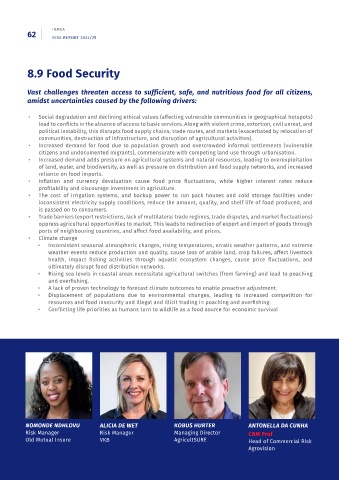
          NOMONDE NDHLOVU           ALICIA DE WET             KOBUS HURTER              ANTONELLA DA CUNHA
          Risk Manager              Risk Manager              Managing Director         CRM Prof
          Old Mutual Insure         VKB                       AgricultSURE              Head of Commercial Risk
                                                                                        Agrovision

