


Page 69 - Risk Report 2024
P. 69
IRMSA
           69
                   RISK REPORT 2024/25


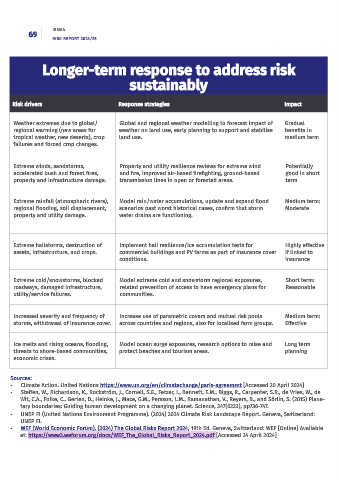
                Longer-term response to address risk

                                              sustainably


     Risk drivers                         Response strategies                                        Impact


      Weather extremes due to global/      Global and regional weather modelling to forecast impact of   Gradual
      regional warming (new areas for      weather on land use, early planning to support and stabilise   benefits in
      tropical weather, new deserts), crop   land use.                                               medium term
      failures and forced crop changes.


      Extreme winds, sandstorms,           Property and utility resilience reviews for extreme wind   Potentially
      accelerated bush and forest fires,   and fire, improved air-based firefighting, ground-based   good in short
      property and infrastructure damage.  transmission lines in open or forested areas.             term
 Threat Identification   Physical Resilience   Supply Chain Vulnerabilities

 Conduct comprehensive risk   Evaluate and improve the   Assess the vulnerability of   Extreme rainfall (atmospheric rivers),   Model rain/water accumulations, update and expand flood   Medium term:
 assessments and business   resilience of facilities,   supply chains to weather-  regional flooding, soil displacement,   scenarios past worst historical cases, confirm that storm   Moderate
 impact analyses to identify   equipment, and infrastructure   related disruptions and develop   property and utility damage.  water drains are functioning.
 potential threats posed by   to withstand extreme weather   contingency plans, e.g. diversify
 extreme weather events and   conditions, e.g. reinforce   suppliers, secure alternative
 climate change (include mapping   buildings, install backup power   transportation routes, and maintain
 out locations and operations   systems, and upgrade drainage   buffer stocks of critical materials or   Extreme hailstorms, destruction of   Implement hail resilience/ice accumulation tests for   Highly effective
 that are particularly vulnerable   and flood protection systems.  components.  assets, infrastructure, and crops.  commercial buildings and PV farms as part of insurance cover   if linked to
 to events like flooding, droughts,        conditions.                                               insurance
 heat waves, or severe storms).

 Data Resilience   Alternative Work Spaces   Emergency Response and   Extreme cold/snowstorms, blocked   Model extreme cold and snowstorm regional exposures,   Short term:
 Protect critical business data   Develop temporary relocation   Evacuation   roadways, damaged infrastructure,   related prevention of access to have emergency plans for   Reasonable
                                           communities.
      utility/service failures.
 from weather-related damage or   of operations or remote work   Establish comprehensive emergency
 power outages, with robust and   arrangements to deploy in the   response and evacuation plans for
 accessible data redundancy and   event of disrupted access to   employees and customers (with   Increased severity and frequency of   Increase use of parametric covers and mutual risk pools   Medium term:
 recovery systems, such cloud-  primary business locations due   regular drills and training sessions   storms, withdrawal of insurance cover.  across countries and regions, also for localised farm groups.  Effective
 based or off-site data centres.  to extreme weather events.  to ensure effective execution during
 emergencies).
      Ice melts and rising oceans, flooding,   Model ocean surge exposures, research options to raise and   Long term
 Risk Financing   Employee Support  Stakeholder Coordination  threats to shore-based communities,   protect beaches and tourism areas.  planning
      economic crises.
 Review insurance policies in   Develop arrangements to support  Collaborate with local authorities,
 context of dynamic BCPs and to   employees affected by extreme   emergency services, and community
 cover weather-related risks, such   weather events, e.g. temporary   organisations to coordinate   Sources:
 as property damage, business   housing, transport assistance,   response efforts and agree to share   •   Climate Action. United Nations https://www.un.org/en/climatechange/paris-agreement [Accessed 20 April 2024]
 interruption, and liabilities.  counselling services, access to   resources during extreme weather   •   Steffen, W., Richardson, K., Rockström, J., Cornell, S.E., Fetzer, I., Bennett, E.M., Biggs, R., Carpenter, S.R., de Vries, W., de
 necessary items such as meals,   events.  Wit, C.A., Folke, C., Gerten, D., Heinke, J., Mace, G.M., Persson, L.M., Ramanathan, V., Reyers, B., and Sörlin, S. (2015) Plane-
 water, blankets, and clothing.  tary boundaries: Guiding human development on a changing planet. Science, 347(6223), pp736-747.
    •   UNEP FI (United Nations Environment Programme). (2024) 2024 Climate Risk Landscape Report. Geneva, Switzerland:
 Climate Change Mitigation  Continuity Testing   External Trend Monitoring  UNEP FI.

 Implement sustainable and   Regularly review and test   Collaboration with industry experts,   •   WEF (World Economic Forum). (2024) The Global Risks Report 2024, 19th Ed. Geneva, Switzerland: WEF [Online] Available
 climate friendly practices,   extreme weather scenarios and   meteorological agencies, and   at: https://www3.weforum.org/docs/WEF_The_Global_Risks_Report_2024.pdf [Accessed 24 April 2024]
 e.g. reduce greenhouse gas   BCPs to identify gaps and refine   relevant Government authorities
 emissions, promote energy   responses.  to stay informed on the potential
 efficiency, and support renewable   impacts of climate change on
 energy sources.  operations.

