


Page 74 - Risk Report 2024
P. 74
IRMSA
           74      RISK REPORT 2024/25


           8.12 Skills


           The NDP envisions a transformative educational system to achieve economic growth and
           social equality, by providing all learners and students with quality education to equip
           them to thrive in a rapidly changing world of work.


           Risk to educational outcomes that will drive the economy is caused by the following:
           •   Disruptions in educational program and quality mix caused by weak governance structures and political
               interference leading to instability in policies and funding inconsistencies, result in misalignment between
               market needs, educational programs, and skills outputs. Inadequate organisational development and change
               management fosters resistance and inefficient implementation of changes to deliver quality education
               frameworks and curriculums. Failure to adapt curriculums to technological advancements and industry needs
               produces graduates lacking essential skills which reduces their employability. Insufficient consideration of
               inclusivity principles (not limited to language barriers) in curriculum design perpetuates inequalities and
               marginalises under-represented groups.
           •   Demographic shifts affecting educational systems through changing generational dynamics and population
               growth, which  necessitate  adaptations  in teaching  and  learning  methodologies  to  accommodate diverse
               learner needs, placing significant strain on pedagogical and andragogical resources. Resulting pressure can
               adversely affect the effectiveness of educational design and resource allocation, potentially compromising
               the quality of instruction and learning outcomes.
           •   Political and economic uncertainties threaten educational systems, as they may lead to political influence
               exacerbated by economic downturns, resulting in budget constraints. These constraints hamper investment
               in essential resources, including skills development and educational infrastructure, heightening the risk of
               reduced funding for educational agendas, leading to cuts in core educational budgets and reduced investment
               in physical and technological educational infrastructure. The result is compromised quality of education and
               skills development, reduced long-term prospects of the workforce, and economic decline.
           •   Ineffective feeder structures to higher education causes ambiguity in educational pathways. Unclear
               channels from primary and high schools to colleges, universities, and informal learning environments such
               as churches, families, social spaces, and workplaces hinder the efficacy of educational development. This is
               aggravated by limited subject choices (especially in rural schools, where subjects are bundled into streams).


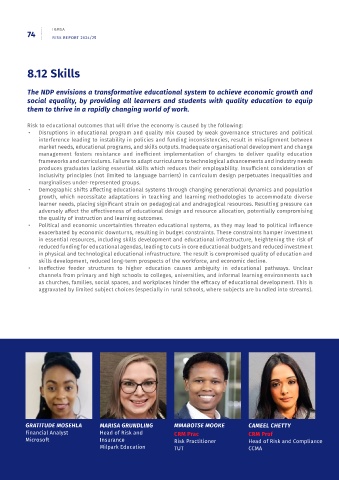
          GRATITUDE MOSEHLA         MARISA GRUNDLING          MMABOTSE MOOKE            CAMEEL CHETTY
          Financial Analyst         Head of Risk and          CRM Prac                  CRM Prof
          Microsoft                 Insurance                 Risk Practitioner         Head of Risk and Compliance
                                    Milpark Education         TUT                       CCMA

