


Page 43 - Risk Report 2024
P. 43
IRMSA
           43
                   RISK REPORT 2024/25


           •   Despite a relatively high Human Development Index score of 0.71 out of 1 SA society is characterised by a high
               Gini coefficient, diverse skills levels, and unequal wealth distributions, which do not support optimal human
               capital development. Low productivity is driven by mental health issues (according to the SA Depression
               and Anxiety Group, 1 in 4 citizens has depression, with employee absenteeism due to depression costing the
               economy R20bn annually).
           •   Interconnected uncertainties (e.g. geopolitical tensions, water, load shedding, corruption, unemployment) are
               compounded by post-election anxiety and a collective national psyche which will manifest in atypical crime
               incidents, social polarisation, high suicide rates, gender-based violence, substance abuse, violent community
               protests, and general discontentment.
           •   Insufficient response to address economic fundamentals and recognition of mental health issues as a critical
               factor for a thriving society. Social service professionals (social workers, child and youth care workers, and
               community development practitioners) are not strategically deployed in communities to offer psycho-social
               support and facilitate the care and protection of marginalised and vulnerable groups in collaboration with
               NPOs.
           •   The triple challenges of poverty, inequality, and unemployment remain the root cause of most of the country’s
               social ills, and if not addressed through coherent policy decisions that promote economic prosperity, multi-
               sectoral collaboration, and inclusion, will edge SA closer to a failed state.


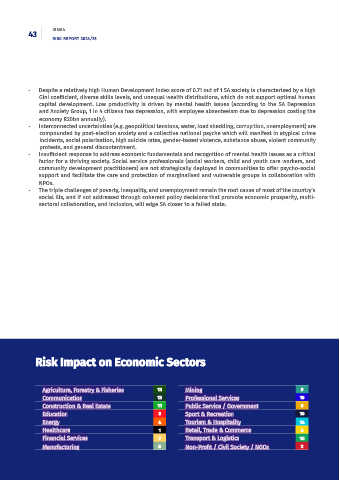
             Risk Impact on Economic Sectors


                Agriculture, Forestry & Fisheries       12        Mining                                   9
                Communication                           13        Professional Services                   15
                Construction & Real Estate              11        Public Service / Government              5
                Education                                3        Sport & Recreation                      16
                Energy                                   4        Tourism & Hospitality                   14
                Healthcare                               1        Retail, Trade & Commerce                6
                Financial Services                       7        Transport & Logistics                   10
                Manufacturing                            8        Non-Profit / Civil Society / NGOs        2

