


Page 42 - Risk Report 2024
P. 42
IRMSA
           42      RISK REPORT 2024/25


           8.4 Social Security


           Increasing poverty in SA is characterised by economic exclusion, lower education levels,
           and vulnerable households.

           Economic policies aimed at redistribution in the social security net have resulted in SA having the highest share
           of GDP devoted to social security of any sub-Saharan country, yet poverty levels remain high. For a quarter (23.5%)
           of SA households, grants are the primary source of income (increased to 28 million beneficiaries or 44% of the
           population, including SRD grants at ~R260bn annually). This situation creates extreme risk of social upheaval if
           not alleviated urgently.


           This risk is mainly driven by the following:
           •   Emerging evidence-based international consensus is that effective social security promotes growth and
               development. Although in SA, this has reduced aggregate poverty, improved school attendance, and reduced
               levels of stunting in children, the social security system remains fragmented, poorly coordinated, inadequate,
               and poorly managed. Reforms, whilst it will not be without challenges, must result in greater inclusivity and
               accommodation of inter alia informal and atypical workers.
           •   Despite this, poverty and inequality remain high due to unequal resource distribution, poor educational
               outcomes, and insufficient entry-level jobs. Related social and fiscal costs are immeasurable and threaten
               the sustainability of the system.
           •   Unemployment remains a pressing economic, social, and policy challenge. Unemployment increased to
               7.9m (32.1%) in March 2024, driven by a growthless economy, structural mismatches in the labour market,
               and automation. This may lead to increased crime, deteriorating health, and social unrest. Less rigid labour
               practices and constant reskilling of workers are needed. Equally, the social compact between Government,
               private sector, and civil society to ignite the economy should be re-established and focus on the youth
               specifically, who are more significantly impacted by high unemployment rates.


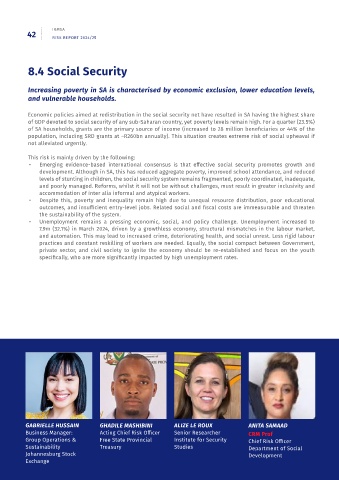
          GABRIELLE HUSSAIN         GHADILE MASHIBINI         ALIZE LE ROUX             ANITA SAMAAD
          Business Manager:         Acting Chief Risk Officer  Senior Researcher        CRM Prof
          Group Operations &        Free State Provincial     Institute for Security    Chief Risk Officer
          Sustainability            Treasury                  Studies                   Department of Social
          Johannesburg Stock                                                            Development
          Exchange

