


Page 159 - Risk Report 2024
P. 159
IRMSA
           159
                   RISK REPORT 2024/25


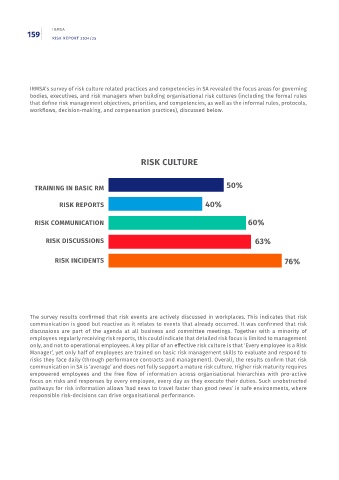
            IRMSA’s survey of risk culture related practices and competencies in SA revealed the focus areas for governing
            bodies, executives, and risk managers when building organisational risk cultures (including the formal rules
            that define risk management objectives, priorities, and competencies, as well as the informal rules, protocols,
            workflows, decision-making, and compensation practices), discussed below.


                                                   RISK CULTURE


                                                                                 50%
             TRAINING IN BASIC RM

                      RISK REPORTS                                       40%


             RISK COMMUNICATION                                                         60%


                 RISK DISCUSSIONS                                                          63%


                    RISK INCIDENTS                                                                   76%


            The survey results confirmed that risk events are actively discussed in workplaces. This indicates that risk
            communication is good but reactive as it relates to events that already occurred. It was confirmed that risk
            discussions are part of the agenda at all business and committee meetings. Together with a minority of
            employees regularly receiving risk reports, this could indicate that detailed risk focus is limited to management
            only, and not to operational employees. A key pillar of an effective risk culture is that ‘Every employee is a Risk
            Manager’, yet only half of employees are trained on basic risk management skills to evaluate and respond to
            risks they face daily (through performance contracts and management). Overall, the results confirm that risk
            communication in SA is ‘average’ and does not fully support a mature risk culture. Higher risk maturity requires
            empowered employees and the free flow of information across organisational hierarchies with pro-active
            focus on risks and responses by every employee, every day as they execute their duties. Such unobstructed
            pathways for risk information allows ‘bad news to travel faster than good news’ in safe environments, where
            responsible risk-decisions can drive organisational performance.


           Regulatory Insight

