


Page 157 - Risk Report 2024
P. 157
IRMSA
           157
                   RISK REPORT 2024/25


        11.2  Organisational Culture


        Organisations have unique cultures, shaped by the social culture of their employees. The social culture shapes
        the shared values, beliefs, behaviours, and norms in workplaces, and directs how employees make decisions and
        interact with their colleagues. Organisational cultures are further informed by their missions, leadership styles,
        and history, influencing how they operate and their different subcultures. Organisations that incorporate dili-
        gence and employee wellness into their cultures influence risk cultures positively.


        One of SA’s strengths is its strong focus on risk management. Organisations should integrate and embed risk
        management more directly into their designs and operations, instead of treating it as a separate activity. Risk
        resources should be dedicated to thoroughly interrogate organisations’ daily activities in pursuit of their goals.
        This dedicated risk focus is different from internal audit or corporate governance; it is proactive rather than re-
        active and provides safe spaces for organisations to learn from failures without fear. The courage to be exposed
        internally, without the consequences of risks materialising, is what most organisations lack.

        Elevating the hierarchical positioning of CROs (reporting functionally to Chief Executives, Risk Committees, or
        Boards) will discourage the tendency to subordinate risk functions to other functions, which dampens rather than
        strengthens, institutional risk culture deepening efforts. This comes with the responsibility for risk professionals
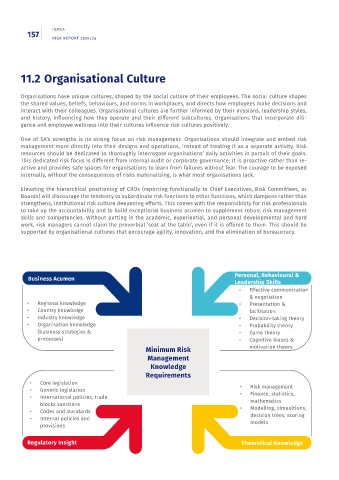
        to take up the accountability and to build exceptional business acumen to supplement robust risk management
        skills and competencies. Without putting in the academic, experiential, and personal developmental and hard
        work, risk managers cannot claim the proverbial ‘seat at the table’, even if it is offered to them. This should be
        supported by organisational cultures that encourage agility, innovation, and the elimination of bureaucracy.


                                                                                   Personal, Behavioural &
           Business Acumen
                                                                                   Leadership Skills
                                                                                     •   Effective communication
                                                                                         & negotiation
           •   Regional knowledge                                                    •   Presentation &
           •   Country knowledge                                                         facilitation
           •   Industry knowledge                                                    •   Decision-taking theory
           •   Organisation knowledge                                                •   Probability theory
              (business strategies &                                                 •   Game theory
              processes)                                                             •   Cognitive biases &
                                                                                         motivation theory
                                                    Minimum Risk
                                                     Management
                                                      Knowledge
                                                    Requirements
            •   Core legislation
            •   Generic legislation                                                  •   Risk management
            •   International policies, trade                                        •   Finance, statistics,
               blocks sanctions                                                          mathematics
            •   Codes and standards                                                  •   Modelling, simualtions,
            •   Internal policies and                                                    decision trees, scoring
               provisions                                                                models


           Regulatory Insight                                                         Theoretical Knowledge

