


Page 158 - Risk Report 2024
P. 158
IRMSA
           158     RISK REPORT 2024/25


            11.3  Risk Culture


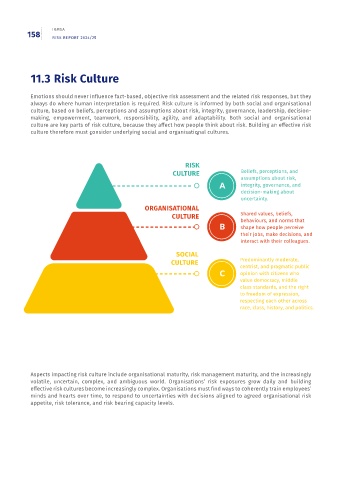
            Emotions should never influence fact-based, objective risk assessment and the related risk responses, but they
            always do where human interpretation is required. Risk culture is informed by both social and organisational
            culture, based on beliefs, perceptions and assumptions about risk, integrity, governance, leadership, decision-
            making, empowerment, teamwork, responsibility, agility, and adaptability. Both social and organisational
            culture are key parts of risk culture, because they affect how people think about risk. Building an effective risk
            culture therefore must consider underlying social and organisational cultures.


                                                                  RISK
                                                              CULTURE                 Beliefs, perceptions, and
                                                                                      assumptions about risk,
                                                                                      integrity, governance, and
                                                                                      decision-making about                         TRAINING IN BASIC RM
                                                                                      uncertainty.
                                                                                                                                             RISK REPORTS
                                                    ORGANISATIONAL
                                                             CULTURE                  Shared values, beliefs,
                                                                                      behaviours, and norms that                    RISK COMMUNICATION
                                                                                      shape how people perceive
                                                                                      their jobs, make decisions, and
                                                                                      interact with their colleagues.                   RISK DISCUSSIONS

                                                               SOCIAL
                                                             CULTURE                 Predominantly moderate,                               RISK INCIDENTS
                                                                                     centrist, and pragmatic public
                                                                                     opinion with citizens who
                                                                                     value democracy, middle
                                                                                     class standards, and the right
                                                                                     to freedom of expression,
                                                                                     respecting each other across
                                                                                     race, class, history, and politics.


            Aspects impacting risk culture include organisational maturity, risk management maturity, and the increasingly
            volatile, uncertain, complex, and  ambiguous world. Organisations’ risk exposures grow daily and building
            effective risk cultures become increasingly complex. Organisations must find ways to coherently train employees’
            minds and hearts over time, to respond to uncertainties with decisions aligned to agreed organisational risk
            appetite, risk tolerance, and risk bearing capacity levels.

