


Page 94 - Risk Report 2024
P. 94
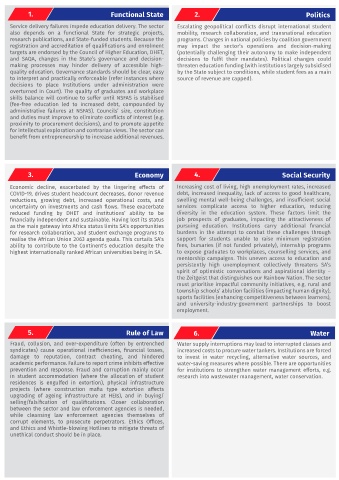
1.                           Functional State             2.                                      Politics

     Service delivery failures impede education delivery. The sector   Escalating geopolitical conflicts disrupt international student
     also  depends  on a  functional State for  strategic  projects,   mobility, research collaboration, and transnational education
     research publications, and State-funded students. Because the   programs. Changes in national policies by coalition government
     registration and accreditation of qualifications and enrolment   may impact the sector’s operations and decision-making
     targets are endorsed by the Council of Higher Education, DHET,   (potentially challenging their autonomy to make independent
     and SAQA, changes in the State’s governance and decision-  decisions to fulfil their mandates). Political changes could
     making processes may hinder delivery of accessible high-  threaten education funding (with institutions largely subsidised
     quality education. Governance standards should be clear, easy   by the State subject to conditions, while student fees as a main
     to interpret and practically enforceable (refer instances where   source of revenue are capped).
     decisions to place Institutions under administration were
     overturned in Court). The quality of graduates and workplace
     skills balance will continue to suffer until NSFAS is stabilised
     (fee-free education led to increased debt, compounded by
     administrative failures at NSFAS). Councils’ size, constitution
     and duties must improve to eliminate conflicts of interest (e.g.
     proximity to procurement decisions), and to promote appetite
     for intellectual exploration and contrarian views. The sector can
     benefit from entrepreneurship to increase additional revenues.


           3.                                   Economy              4.                             Social Security
     Economic decline, exacerbated by the lingering effects of   Increasing cost of living, high unemployment rates, increased
     COVID-19, drives student headcount decreases, donor revenue   debt, increased inequality, lack of access to good healthcare,
     reductions, growing debt, increased operational costs, and   swelling mental well-being challenges, and insufficient social
     uncertainty on investments and cash flows. These exacerbate   services complicate access to higher education, reducing
     reduced funding by DHET and institutions’ ability to be   diversity in the education system. These factors limit the
     financially independent and sustainable. Having lost its status   job prospects of graduates, impacting the attractiveness of
     as the main gateway into Africa status limits SA’s opportunities   pursuing education. Institutions carry additional financial
     for research collaboration, and student exchange programs to   burdens in the attempt to combat these challenges through
     realise the African Union 2063 agenda goals. This curtails SA’s   support  for  students  unable  to  raise  minimum  registration
     ability to contribute to the Continent’s education despite the   fees, bursaries (if not funded privately), internship programs
     highest internationally ranked African universities being in SA.   to expose graduates to workplaces, counselling services, and
                                                               mentorship  campaigns.  This  uneven  access  to  education  and
                                                               persistently high unemployment collectively threatens SA’s
                                                               spirit of optimistic conversations and aspirational identity –
                                                               the Zeitgeist that distinguishes our Rainbow Nation. The sector
                                                               must prioritise impactful community initiatives, e.g. rural and
                                                               township schools’ ablution facilities (impacting human dignity),
                                                               sports facilities (enhancing competitiveness between learners),
                                                               and university-industry-government  partnerships to  boost
                                                               employment.


           5.                                Rule of Law             6.                                       Water
     Fraud, collusion, and over-expenditure (often by entrenched   Water supply interruptions may lead to interrupted classes and
     syndicates) cause operational inefficiencies, financial losses,   increased costs to procure water tankers. Institutions are forced
     damage to  reputation,  contract cheating, and hindered   to invest in water recycling, alternative water sources, and
     academic performance. Failure to report crime inhibits effective   water-saving measures where possible. There are opportunities
     prevention and response. Fraud and corruption mainly occur   for institutions to strengthen water management efforts, e.g.
     in  student  accommodation  (where  the  allocation  of  student   research into wastewater management, water conservation.
     residences is engulfed in extortion), physical infrastructure
     projects (where construction mafia type extortion affects
     upgrading of ageing infrastructure at HEIs), and in buying/
     selling/falsification of qualifications. Closer collaboration
     between the sector and law enforcement agencies is needed,
     while cleansing law enforcement agencies themselves of
     corrupt  elements,  to prosecute  perpetrators.  Ethics  Offices,
     and Ethics and Whistle-blowing Hotlines to mitigate threats of
     unethical conduct should be in place.

