


Page 91 - Risk Report 2024
P. 91
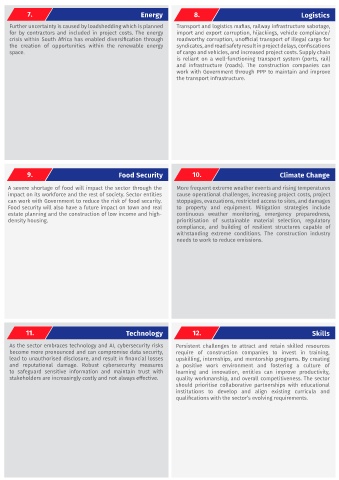
7.                                      Energy            8.                                    Logistics

    Further uncertainty is caused by loadshedding which is planned   Transport and logistics mafias, railway infrastructure sabotage,
    for  by  contractors  and  included  in  project  costs.  The  energy   import and export corruption, hijackings, vehicle compliance/
    crisis within South Africa has enabled diversification through   roadworthy corruption, unofficial transport of illegal cargo for
    the creation of opportunities within the renewable energy   syndicates, and road safety result in project delays, confiscations
    space.                                                     of cargo and vehicles, and increased project costs. Supply chain
                                                               is reliant on a well-functioning transport system (ports, rail)
                                                               and infrastructure (roads). The construction companies can
                                                               work with Government through PPP to maintain and improve
                                                               the transport infrastructure.


           9.                              Food Security             10.                           Climate Change
    A severe shortage of food will impact the sector through the   More frequent extreme weather events and rising temperatures
    impact on its workforce and the rest of society. Sector entities   cause operational challenges, increasing project costs, project
    can work with Government to reduce the risk of food security.   stoppages, evacuations, restricted access to sites, and damages
    Food security will also have a future impact on town and real   to property and equipment. Mitigation strategies include
    estate planning and the construction of low income and high-  continuous weather monitoring, emergency preparedness,
    density housing.                                           prioritisation of sustainable material selection, regulatory
                                                               compliance, and building of resilient structures capable of
                                                               withstanding extreme conditions. The construction industry
                                                               needs to work to reduce emissions.


          11.                                Technology              12.                                       Skills

    As the sector embraces technology and AI, cybersecurity risks   Persistent challenges to attract and retain skilled resources
    become more pronounced and can compromise data security,   require of construction companies to invest in training,
    lead to unauthorised disclosure, and result in financial losses   upskilling, internships, and mentorship programs. By creating
    and reputational damage. Robust cybersecurity measures     a positive work environment and fostering a culture of
    to  safeguard  sensitive  information  and  maintain  trust  with   learning and innovation, entities can improve productivity,
    stakeholders are increasingly costly and not always effective.  quality workmanship, and overall competitiveness. The sector
                                                               should prioritise collaborative partnerships with educational
                                                               institutions  to  develop  and  align  existing  curricula  and
                                                               qualifications with the sector’s evolving requirements.

