


Page 82 - Risk Report 2024
P. 82
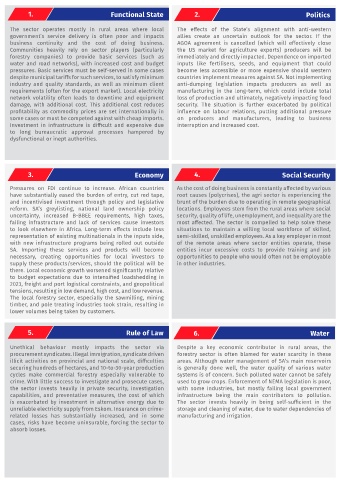
1.                           Functional State             2.                                      Politics


     The  sector  operates  mostly  in  rural  areas  where  local   The effects of the State’s alignment with anti-western
     government’s service delivery is often poor and impacts   allies create an uncertain outlook for the sector. If the
     business continuity and the cost of doing business.       AGOA agreement is cancelled (which will effectively close
     Communities heavily rely on sector players (particularly   the US market for agriculture exports) producers will be
     forestry companies) to provide basic services (such as    immediately and directly impacted. Dependence on imported
     water and road networks), with increased cost and budget   inputs like fertilisers, seeds, and equipment that could
     pressures. Basic services must be self-served in some cases   become less accessible or more expensive should western
     despite municipal tariffs for such services, to satisfy minimum   countries implement measures against SA. Not implementing
     industry and quality standards, as well as minimum client   anti-dumping legislation impacts producers as well as
     requirements (often for the export market). Local electricity   manufacturing in the long-term, which could include total
     network volatility often leads to downtime and equipment   loss of production and ultimately, negatively impacting food
     damage, with additional cost. This additional cost reduces   security. The situation is further exacerbated by political
     profitability as commodity prices are set internationally in   influence on  labour  relations, putting additional pressure
     some cases or must be competed against with cheap imports.   on producers and manufacturers, leading to business
     Investment  in  infrastructure  is  difficult  and  expensive  due   interruption and increased cost.
     to long bureaucratic approval processes hampered by
     dysfunctional or inept authorities.


           3.                                   Economy              4.                             Social Security
     Pressures  on  FDI  continue  to  increase.  African  countries   As the cost of doing business is constantly affected by various
     have substantially eased the burden of entry, cut red tape,   root causes (polycrises), the agri sector is experiencing the
     and incentivised investment through policy and legislative   brunt of the burden due to operating in remote geographical
     reform. SA’s greylisting, national land ownership policy   locations. Employees stem from the rural areas where social
     uncertainty, increased B-BBEE requirements, high taxes,   security, quality of life, unemployment, and inequality are the
     failing infrastructure and lack of services cause investors   most affected. The sector is compelled to help solve these
     to look elsewhere in Africa. Long-term effects include less   situations to maintain a willing local workforce of skilled,
     representation of existing multinationals in the inputs side,   semi-skilled, unskilled employees. As a key employer in most
     with  new  infrastructure  programs  being  rolled  out  outside   of  the  remote  areas  where sector  entities operate,  these
     SA.  Importing  these  services  and  products  will  become   entities incur excessive costs to provide training and job
     necessary, creating opportunities for local investors to   opportunities to people who would often not be employable
     supply these products/services, should the political will be   in other industries.
     there. Local economic growth worsened significantly relative
     to budget expectations due to intensified loadshedding in
     2023, freight and port logistical constraints, and geopolitical
     tensions, resulting in low demand, high cost, and low revenue.
     The local forestry sector, especially the sawmilling, mining
     timber, and pole treating industries took strain, resulting in
     lower volumes being taken by customers.


           5.                                Rule of Law             6.                                       Water

     Unethical behaviour  mostly  impacts the sector  via      Despite a key economic contributor in rural areas, the
     procurement syndicates. Illegal immigration, syndicate driven   forestry sector is often blamed for water scarcity in these
     illicit activities on provincial and national scale, difficulties   areas. Although water management of SA’s main reservoirs
     securing hundreds of hectares, and 10-to-30-year production   is generally done well, the water quality of various water
     cycles make commercial forestry especially vulnerable to   systems is of concern. Such polluted water cannot be safely
     crime. With little success to investigate and prosecute cases,   used to grow crops. Enforcement of NEMA legislation is poor,
     the sector invests heavily in private security, investigation   with  some  industries,  but  mostly  failing  local  government
     capabilities, and preventative measures, the cost of which   infrastructure being the main contributors to pollution.
     is exacerbated by investment in alternative energy due to   The sector invests heavily in being self-sufficient in the
     unreliable electricity supply from Eskom. Insurance on crime-  storage and cleaning of water, due to water dependencies of
     related losses has substantially increased, and in some   manufacturing and irrigation.
     cases, risks have become uninsurable, forcing the sector to
     absorb losses.

