


Page 118 - Risk Report 2024
P. 118
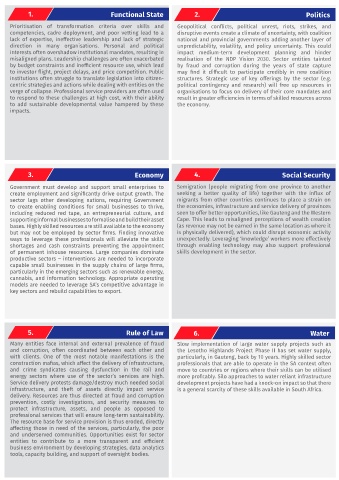
1.                           Functional State             2.                                      Politics

     Prioritisation of transformation criteria over skills and   Geopolitical conflicts, political unrest, riots, strikes, and
     competencies, cadre deployment, and poor vetting lead to a   disruptive events create a climate of uncertainty, with coalition
     lack of expertise, ineffective leadership and lack of strategic   national and provincial governments adding another layer of
     direction in many organisations. Personal and political   unpredictability, volatility, and policy uncertainty. This could
     interests often overshadow institutional mandates, resulting in   impact medium-term development planning and hinder
     misaligned plans. Leadership challenges are often exacerbated   realisation of the NDP Vision 2030. Sector entities tainted
     by budget constraints and inefficient resource use, which lead   by fraud and corruption during the years of state capture
     to investor flight, project delays, and price competition. Public   may find  it difficult to participate credibly in new coalition
     institutions often struggle to translate legislation into citizen-  structures. Strategic use of key offerings by the sector (e.g.
     centric strategies and actions while dealing with entities on the   political contingency and research) will free up resources in
     verge of collapse. Professional service providers are often used   organisations to focus on delivery of their core mandates and
     to respond to these challenges at high cost, with their ability   result in greater efficiencies in terms of skilled resources across
     to add sustainable developmental value hampered by these   the economy.
     impacts.


           3.                                   Economy              4.                             Social Security
     Government  must  develop  and  support  small  enterprises  to   Semigration (people migrating from one province to another
     create employment and significantly drive output growth. The   seeking a better quality of life) together with the influx of
     sector lags other developing nations, requiring Government   migrants from other countries continues to place a strain on
     to create enabling conditions for small businesses to thrive,   the economies, infrastructure and service delivery of provinces
     including reduced red tape, an entrepreneurial culture, and   seen to offer better opportunities, like Gauteng and the Western
     supporting informal businesses to formalise and build their asset   Cape. This leads to misaligned perceptions of wealth creation
     bases. Highly skilled resources are still available to the economy   (as revenue may not be earned in the same location as where it
     but may not be employed by sector firms. Finding innovative   is physically delivered), which could disrupt economic activity
     ways to leverage these professionals will alleviate the skills   unexpectedly. Leveraging ‘knowledge’ workers more effectively
     shortages and cash constraints preventing the appointment   through enabling technology may also support professional
     of permanent inhouse resources. Large  companies  dominate   skills development in the sector.
     productive sectors – interventions are needed to incorporate
     capable small businesses in the supply chains of large firms,
     particularly in the emerging sectors such as renewable energy,
     cannabis, and information technology. Appropriate operating
     models are needed to leverage SA’s competitive advantage in
     key sectors and rebuild capabilities to export.


           5.                                Rule of Law             6.                                       Water
     Many entities face internal and external prevalence of fraud   Slow implementation of large water supply projects such as
     and corruption, often coordinated between each other and   the Lesotho Highlands Project Phase II has set water supply,
     with clients. One of the most notable manifestations is the   particularly, in Gauteng, back by 10 years. Highly skilled sector
     construction mafias, which affect the delivery of infrastructure,   professionals that are able to operate in the SA context often
     and crime syndicates causing dysfunction in the rail and   move to countries or regions where their skills can be utilised
     energy sectors where use of the sector’s services are high.   more profitably. Silo approaches to water reliant infrastructure
     Service delivery protests damage/destroy much needed social   development projects have had a knock-on impact so that there
     infrastructure, and theft of assets directly impact service   is a general scarcity of these skills available in South Africa.
     delivery. Resources are thus directed at fraud and corruption
     prevention, costly investigations, and security measures to
     protect infrastructure, assets, and people as opposed to
     professional services that will ensure long-term sustainability.
     The resource base for service provision is thus eroded, directly
     affecting those in need of the services, particularly, the poor
     and underserved communities. Opportunities exist for sector
     entities to contribute to a more transparent and efficient
     business environment by developing strategies, data analytics
     tools, capacity building, and support of oversight bodies.

