


Page 103 - Risk Report 2024
P. 103
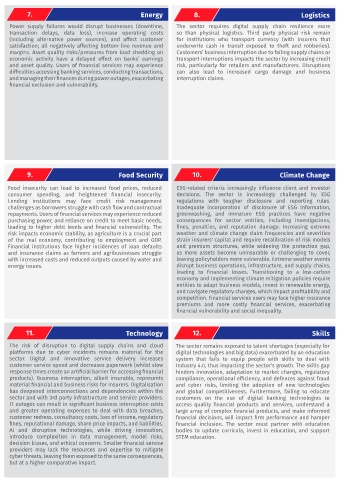
7.                                      Energy            8.                                    Logistics

    Power supply failures would disrupt businesses (downtime,   The  sector  requires  digital  supply  chain  resilience  more
    transaction delays,  data  loss),  increase  operating  costs   so than physical logistics. Third party physical risk remain
    (including alternative power sources), and affect customer   for institutions who transport currency (with insurers that
    satisfaction; all negatively affecting bottom-line revenue and   underwrite cash in transit exposed to theft and robberies).
    margins. Asset quality risks/pressures from load shedding on   Customers’ business interruption due to failing supply chains or
    economic activity have a delayed effect on banks’ earnings   transport interruptions impacts the sector by increasing credit
    and asset quality. Users of financial services may experience   risk, particularly for retailers and manufacturers. Disruptions
    difficulties accessing banking services, conducting transactions,   can  also  lead to  increased cargo  damage and business
    and managing their finances during power outages, exacerbating   interruption claims.
    financial exclusion and vulnerability.


           9.                              Food Security             10.                           Climate Change
    Food insecurity can lead to increased food prices, reduced   ESG-related criteria increasingly influence client and investor
    consumer spending, and heightened financial insecurity.    decisions. The sector is increasingly challenged by ESG
    Lending institutions may  face credit  risk management     regulations with tougher disclosure and reporting rules.
    challenges as borrowers struggle with cash flow and contractual   Inadequate incorporation of disclosure of ESG information,
    repayments. Users of financial services may experience reduced   greenwashing, and immature ESG practices have negative
    purchasing power, and reliance on credit to meet basic needs,   consequences for sector entities, including investigations,
    leading to higher debt levels and financial vulnerability. The   fines, penalties, and reputation damage. Increasing extreme
    risk impacts economic stability, as agriculture is a crucial part   weather and climate change claim frequencies and severities
    of the real economy, contributing to employment and GDP.   strain insurers' capital and require recalibration of risk models
    Financial institutions face higher incidences of loan defaults   and premium structures, while widening the protection gap,
    and insurance claims as farmers and agribusinesses struggle   as more  assets become uninsurable or  challenging to cover,
    with increased costs and reduced outputs caused by water and   leaving policyholders more vulnerable. Extreme weather events
    energy issues.                                             disrupt business operations, infrastructure, and supply chains,
                                                               leading to financial losses. Transitioning to a low-carbon
                                                               economy and implementing climate mitigation policies require
                                                               entities to adapt business models, invest in renewable energy,
                                                               and navigate regulatory changes, which impact profitability and
                                                               competition. Financial services users may face higher insurance
                                                               premiums and more costly financial services, exacerbating
                                                               financial vulnerability and social inequality.


          11.                                Technology              12.                                       Skills

    The risk of disruption to digital supply chains and cloud   The sector remains exposed to talent shortages (especially for
    platforms due to cyber incidents remains material for the   digital technologies and big data) exacerbated by an education
    sector. Digital and innovative service delivery increases   system that fails to equip people with skills to deal with
    customer service speed and decreases paperwork (whilst slow   Industry 4.0, thus impacting the sector’s growth. The skills gap
    response times create an artificial barrier for accessing financial   hinders innovation, adaptation to market changes, regulatory
    products).  Business  interruption,  albeit  insurable,  represents   compliance, operational efficiency, and defences against fraud
    material financial and business risks for insurers. Digitalisation   and cyber risks, limiting the adoption of new technologies
    has deepened interconnections and dependencies within the   and global competitiveness. Furthermore, failing to educate
    sector and with 3rd party infrastructure and service providers.   customers on the use of digital banking technologies to
    IT outages can result in significant business interruption costs   access quality financial products and services, understand a
    and  greater  operating  expenses  to deal  with  data  breaches,   large array of complex financial products, and make informed
    customer redress, consultancy costs, loss of income, regulatory   financial decisions, will impact firm performance and hamper
    fines, reputational damage, share price impacts, and liabilities.   financial inclusion. The sector must partner with education
    AI and disruptive technologies, while driving innovation,   bodies to update curricula, invest in education, and support
    introduce complexities in data management, model risks,    STEM education.
    decision biases, and ethical concerns. Smaller financial service
    providers  may lack the resources  and  expertise  to mitigate
    cyber threats, leaving them exposed to the same consequences,
    but at a higher comparative impact.

